
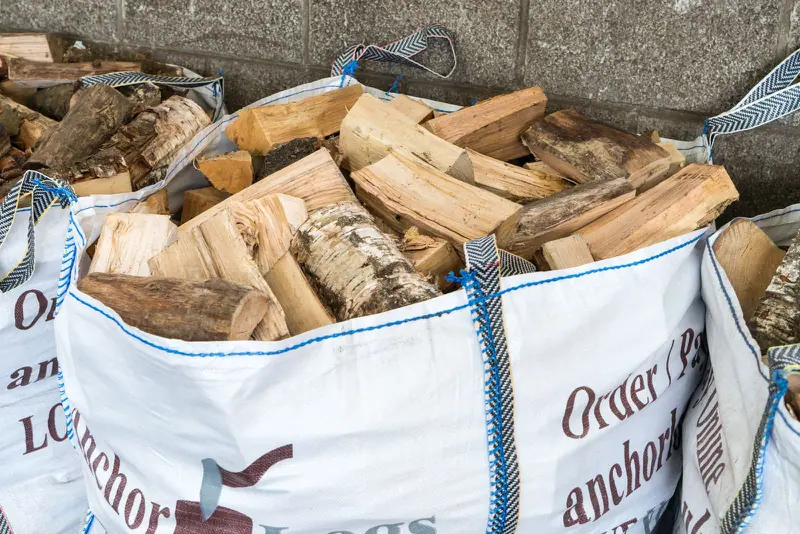
Buy logs that are dry, the right size for your stove or fire, and sold by volume by someone who will tell you exactly what's in the bag. In England, look for the Ready to Burn logo: it means the wood is certified at 20% moisture or less, so you can burn it the day it arrives. Get those right and the rest is easy.
Dry wood comes first.
Moisture matters more than anything else. The water in a log has to boil off before the wood will burn, so wet logs smoulder, give less heat and coat your flue and stove glass with tar. Forest Research says well-seasoned logs can hold roughly twice the useful heat of green ones, and GOV.UK says dry wood gives more heat and less soot than wet wood.
That's why, since 1 May 2021, wood sold in England in volumes under 2 cubic metres has to be certified Ready to Burn, which confirms a moisture content of 20% or less (GOV.UK). Bigger loads don't need certifying, but they must come with a notice explaining how to dry the wood first. So if you're offered a cheap trailer load, expect to stack it and wait: the government's notice says at least two years in a sunny, airy spot with the rain kept off.
Kiln-dried, seasoned or green?
- Kiln-dried: dried in a heated kiln. Defra says kilning can take wood from unseasoned to ready to burn in a matter of days. Ours are kiln dried at our yard in Gargrave, near Skipton.
- Seasoned: air dried for a while. Defra points out there's no set standard for the word, so ask how long and how it was stored, or test it yourself.
- Green or wet: freshly cut. Cheaper, because the drying is now your job.
Our kiln-dried vs seasoned guide goes into more detail.
How to check what you're buying.
Certified wood has to be sold with the Ready to Burn logo, the supplier's name and a unique certificate number, on the bag or next to the price, and online the logo should sit with the product (GOV.UK). Firewood certificate numbers start with WS (Woodsure), and you can look a supplier up on the Ready to Burn website. Ours are WS226/00001 for logs and WS226/00002 for kindling.
Defra calls moisture meters cheap and easy to use. Woodsure's method: take three logs from different parts of the pile, split each one, wipe the fresh face, push the pins in across the grain and average the readings. Test at room temperature, not straight from a frosty store. No meter? Defra says dry logs feel lighter than wet ones of the same size, sound hollow when knocked, and often have cracked ends and loose bark.
What a good bag looks like.
Logs of a similar length, mostly split pieces, and nothing that isn't firewood: no offcuts, pallet wood, twigs or mud. Bulk bags are usually filled loose, and Woodsure says loose logs can hold up to 15 to 20% less wood than the same space stacked. Odd bits and branches leave even bigger gaps, and gaps are air you've paid for.
Buy by volume, not weight.
A wet log weighs more than a dry one, and Woodsure notes that oak or ash can weigh almost twice as much as pine or spruce for the same space. So weight tells you more about water and species than about how much fire you're getting. Forest Research suggests asking exactly what a supplier means by a "load". Ours is simple: one bulk bag, 0.85m each way (about 0.6 cubic metres), delivered and left in the bag.
Hardwood or softwood?
For a stove or open fire, dry hardwood is usually the better buy. Defra says hardwoods are denser and burn for longer, while softwoods light more easily but burn faster and give less heat log for log. Dry softwood is handy for kindling and quick fires. Our hardwood vs softwood guide has the full comparison.
Get the size right.
Logs need to fit your firebox with room for air around them, so check your stove's manual for the longest log it takes. Our standard logs are cut to about 25cm, give or take 2cm, which suits most stoves and open fires. We also do smaller birch for compact stoves, larger logs for big wood burners and extra small logs for pizza ovens.
Stove or open fire?
Same logs, very different results. Forest Research puts a typical open fire at around 25% efficient and a log stove at around 70%, because an open fire sends warm room air up the chimney. Defra adds that stoves produce much less smoke than open fires. Burning logs on an open fire? Forest Research recommends a metal base plate over a coal grate and a fine mesh spark guard.
How much will you need?
It depends on your stove or fire and how often you light it, so we'd rather ask than guess. Ring the office on 01756 748342, tell us what you burn and how many evenings a week, and we'll give you a steer.
Keep it dry once it's home.
Even Ready to Burn logs can soak moisture back up if they're stored badly. Woodsure recommends a covered, slatted store off the ground with air moving through it and nothing dripping onto it, and bringing in only a couple of days' worth at a time, kept well away from the stove. See our guide to storing logs.
Smoke control areas and safety.
In a smoke control area you can only burn wood on a Defra exempt appliance (GOV.UK). North Yorkshire Council says most of Skipton and Harrogate, and parts of South Craven, are smoke control areas. This is a general summary, not legal advice: check with your council.
Never burn painted or treated wood, old furniture, pallets or fence panels (Defra). HETAS recommends sweeping the chimney at least twice a year when burning wood, servicing the appliance at least once a year and testing your carbon monoxide alarm regularly.
Questions people ask.
Is kiln-dried firewood worth it?
If you want to burn it the day it arrives, yes. Kiln-dried, Ready to Burn certified logs are at 20% moisture or less. Wet wood costs less but needs space, a good store and, according to GOV.UK, at least two years before it's ready.
Do you sell logs by weight?
No, by volume. Each bulk bag is 0.85m x 0.85m x 0.85m. Weight changes with moisture and species, so it's a poor guide to how much heat you're buying.
How do I know your logs are Ready to Burn?
Our certificate numbers are WS226/00001 for logs and WS226/00002 for kindling. You can check them on the Ready to Burn website.
Do I need to be in for the delivery?
No. Tell us at checkout where you'd like the bags left and any days you can't take a delivery. We text or call you when your delivery day is booked.
What we'd suggest.
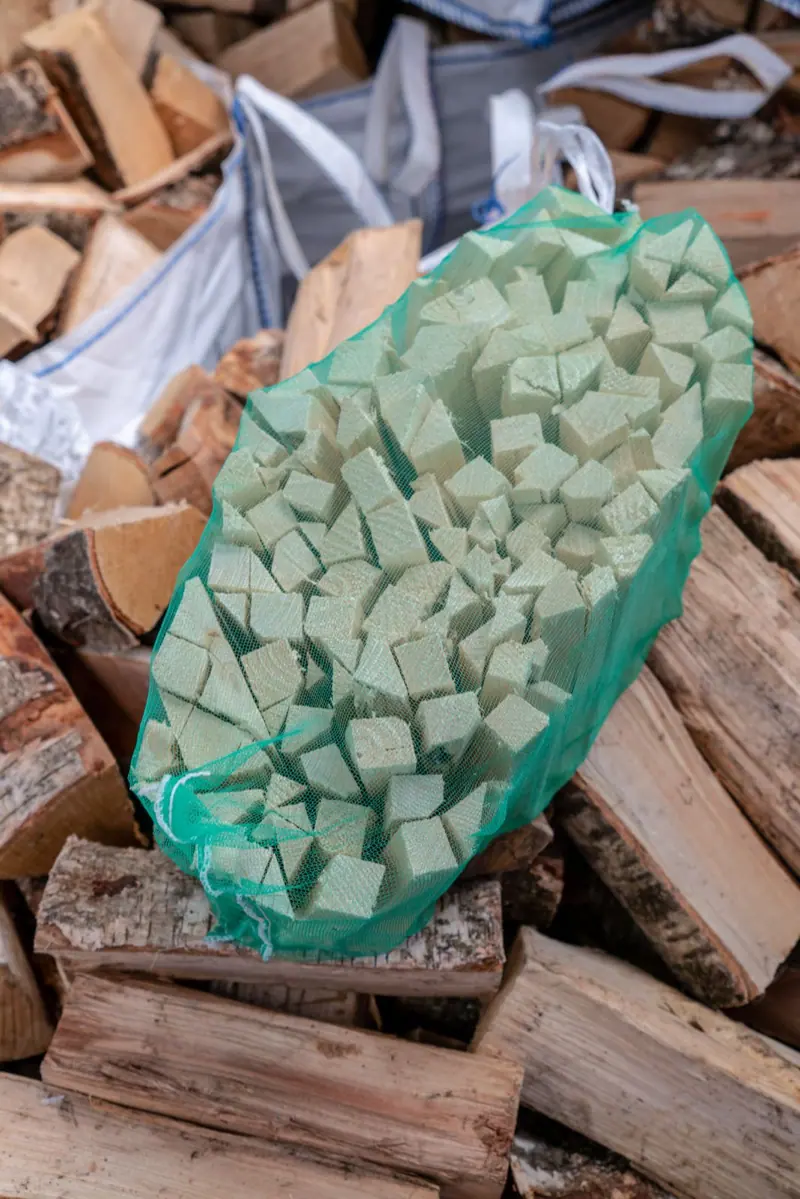
Not sure where to start? Our Kiln Dried Mixed Hardwoods are a good all-rounder for any stove. Add Silver Birch if you like a fire that catches quickly, choose nets if you're short of space, and keep a bag of kindling by the door. Delivery is free with a minimum order of £80; see how delivery works.
Kiln Dried Mixed Hardwoods
Our best seller. A good all-rounder for any stove.
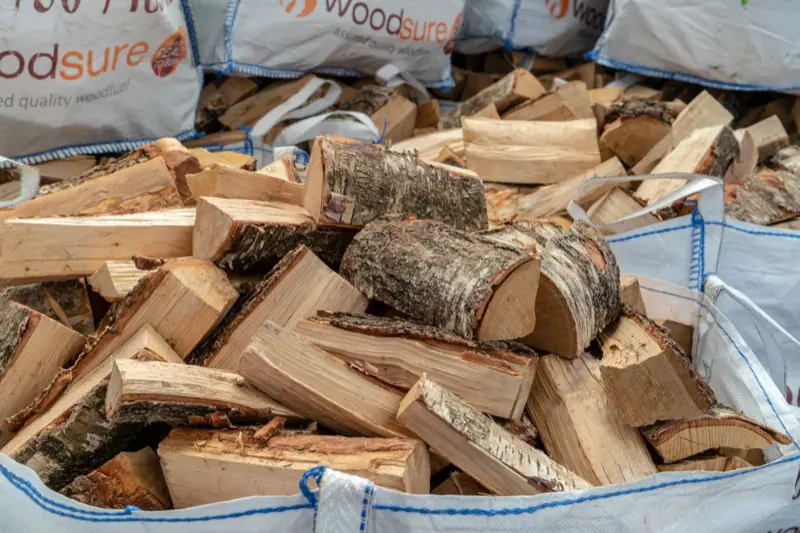
Kiln Dried Silver Birch
Lights easily, burns bright. Lovely bark.
Sources.
- Selling wood for domestic use in England (GOV.UK)Checked 19 October 2026
- Customer notice for wood sold in volumes of 2 cubic metres or more in England (GOV.UK)Checked 19 October 2026
- Restrictions on sale of coal and wet wood for home burning begin (GOV.UK, 1 May 2021)Checked 19 October 2026
- How to get the most from your stove or open fire: buying, storing and seasoning wood (Defra)Checked 19 October 2026
- Open fires and wood-burning stoves: a practical guide (Defra, April 2022)Checked 19 October 2026
- Wood as Fuel: a guide to choosing and drying logs (Forest Research)Checked 19 October 2026
- How to use a moisture meter (Woodsure)Checked 19 October 2026
- Loose firewood vs stacked firewood (Woodsure)Checked 19 October 2026
- A guide to burn responsibly (Woodsure)Checked 19 October 2026
- Storing firewood indoors and outdoors (Woodsure)Checked 19 October 2026
- Ready to Burn: consumersChecked 19 October 2026
- Smoke control areas: the rules (GOV.UK)Checked 19 October 2026
- Smoke control areas (North Yorkshire Council)Checked 19 October 2026
- HETAS consumer leafletChecked 19 October 2026